

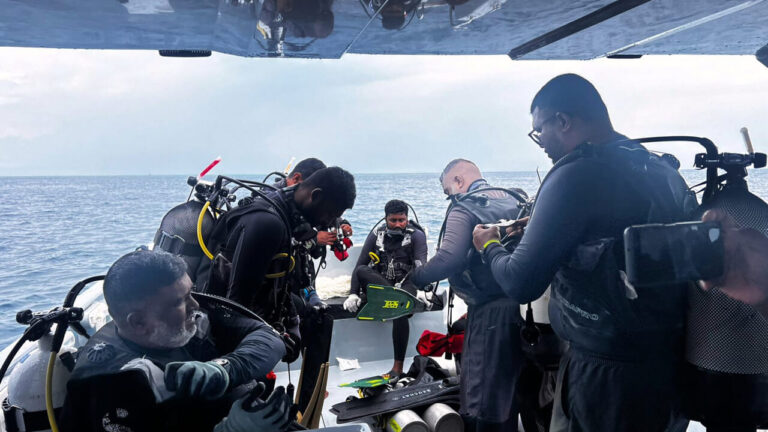
The bodies of the Italian divers who died in the Maldives have all been brought back to Italy. After the arrival in recent days of the first body, that of Gianluca Benedetti from Padua, on Saturday those of the marine biologist Monica Montefalcone, professor at the University of Genoa, her daughter Giorgia Sommacal, the researcher Muriel Oddenino and the marine biologist Federico Gualtieri landed in Fiumicino. While waiting for the autopsies, which could provide useful elements to reconstruct the causes of the tragedy, the Maldivian government seems intent on introducing a new rule to prevent similar accidents from happening again in the future.
The new law
Yesterday, Sunday 24 May, the Maldives government announced its intention to introduce a new law on technical diving, which would modify the current regulatory limit of 30 meters, which Italian divers would have exceeded to explore the underwater cave. Government spokesperson, Mohamed Hussain Shareef, explained that future legislation will serve to specifically regulate this type of deep-sea activity. At the moment, the Maldives remains one of the very few global tourist destinations where technical diving is still prohibited. By starting this legislative process, the executive aims to fill the regulatory gap and authorize advanced diving practices under strict state control.
During a press briefing, Shareef specified that the new law will allow the issuing of special permits to regularly certified research and technical divers: “These are activities conducted by scientists and professionals using specialized equipment. These dives require specific skills and a very high level of experience. For this reason, the entire sector will be regulated through extremely rigorous guidelines.” Preliminary discussions for the drafting of the law text have just begun. However, according to the spokesperson, both the approval of the rule and the definition of the implementing regulations should proceed very quickly: “The definitive regulatory framework – added the spokesperson – will be developed in close consultation with operators in the tourism and seaside sector”.
Tech-wreck diving
The law would impose the need to obtain a special permit to dive in “tech-wreck” missions, an advanced underwater activity that is not clearly covered in the current law. Generally speaking, these are dives that exceed the depth limits established for recreational activity (set at 30 meters in the Maldives) and which involve the exploration of closed or obstructed environments, such as wrecks, submarines, tunnels and caves. By exceeding these critical thresholds, the hydrostatic pressure increases and, with it, the risks for the human organism grow exponentially.
To deal with such dangers, divers employ high-tech equipment. In addition to the use of rebreather systems (now widespread also in the recreational sector), depth management requires the use of special gaseous mixtures in the cylinders. Alongside the common nitrox (oxygen and nitrogen), the most popular options include trimix or helair (composed of oxygen, nitrogen and helium) and heliox (oxygen and helium). The presence of helium is a crucial factor for safety: thanks to its low density, this gas allows you to breathe easily at great depths. In this way, the risk of oxygen toxicity and nitrogen narcosis is drastically reduced, two of the most lethal phenomena linked to the increase in gas pressure on the diver’s tissues.