

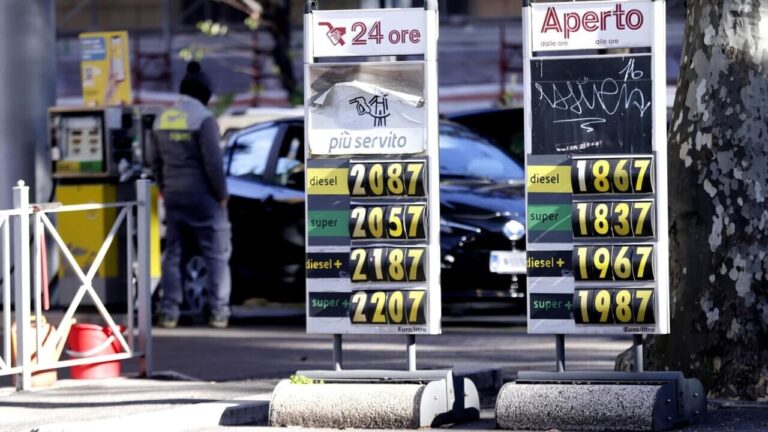
Here we go again. The cut in excise duties on fuel decided by the government to deal with the surge in prices caused by the war in Iran and the closure of the Strait of Hormuz expires on Friday 22 May. What could happen? The executive led by Giorgia Meloni has already announced that it is working to try to extend the measure, and a Council of Ministers is scheduled for tomorrow evening from which the approval for the extension should come. The central issue is always that of the economic resources necessary to deal with the high cost of energy, without which the current discount of 24.4 cents per liter on diesel and 6.1 cents per liter on petrol would go up in smoke.
What does the government do?
According to Today’s estimates, based on the resources allocated by the government to which we added the missed VAT collection, in the month of May alone the measure cost around 400 million euros, to which must be added the 900 million already spent in March and April (when the discount on petrol, then reduced, was more generous). Given the political will to extend the excise duty cut measure, the challenge at the moment for the Meloni government is to find the resources to be able to do so.
At the moment it is not possible to use the mechanism of the so-called “mobile excise duties”, which allows the use of the extra VAT revenue linked to the increase in fuel prices: the resources accrued in May will in fact only be available starting from the second half of June. And therefore to avoid a new increase in prices at the distributor, the government is working to identify alternative coverage.
In any case, the government’s intention seems clear. The Minister of Economy, Giancarlo Giorgetti, also spoke about the topic in recent days: he made it known that “the issue of renewing the discount on excise duties” will also be addressed in the Council of Ministers on Friday, and he added that he “believes that we will go in this direction”. In short: there should be no surprises on this point.
The derogation from the stability pact
On Wednesday 20 May, at the end of the G7 finance meeting held in Paris, Giorgetti explained that on Friday “a Council of Ministers is expected in which measures will be taken, certainly on road transport, on local public transport, i.e. the sectors affected. There is also the issue of renewing the discount on excise duties, I believe we will go in this direction, we are working on financial coverage, which is never easy in the absence of exceptions to the stability pact, so we are also preparing for the meeting with the categories”.
The Stability Pact is the set of rules that coordinates the budgetary policies of the European Union countries, with the aim of guaranteeing healthy and sustainable public finances to avoid economic imbalances.
It’s not a detail at all. The negotiation at European level on possible exceptions to the stability pact is intertwined with the issue of excise duties and the funds to finance their cuts. “There is not only the exemption, there are many ways to get to the result, we are exploring them all”, however, Giancarlo Giorgetti clarified when responding to journalists on the talks on the sidelines of the meeting to advance Italy’s request to the EU to also extend the safeguard clause already foreseen for defense to energy. “We are working, it is a complex thing, I believe that there are no prejudices, there is awareness of the exceptional situation, after which there are various forms, various modalities, various possibilities. We are exploring them all”, explained the minister.
Money and possible increases
The cut in excise duties ordered by the government last March 18, and the subsequent extensions until May 22, have so far cost state coffers around 1.3 billion euros, with an impact of around 20 million euros per day considering the entire period of validity of the measure. And to extend the discount currently in force on petrol and diesel until next June 12, the government needs to find resources for around 340 million euros.
Without the discount, things would change. And not by little. A possible failure to extend the excise duty cut would bring petrol above 2 euros per liter and diesel above 2.2 euros. Without an extension of the measure, petrol would increase by 6.1 euro cents per litre, and based on the average prices of Tuesday 19 May it would reach 2.01 per liter on the ordinary network: this would be an increase of around three euros at full capacity. As regards diesel, without the current discount the price would rise to 2.22 euros per litre, with a drop of around 12.2 euros for a full tank.