

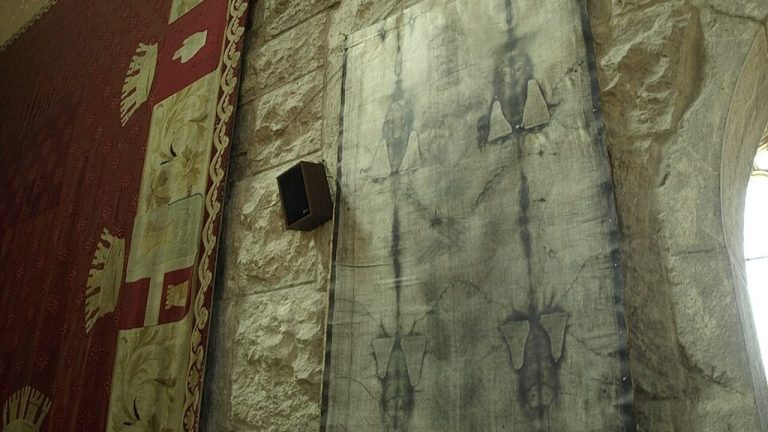
Jesus was certainly not stingy in distributing relics. There are at least seven ampoules of his blood kept Italy, France and Germany. Fragments of meat, bones, nails and splinters from the cross. Sacre thorns, veils and southwashes, and in some moments there have been up to 18 “foreskin saints” distributed in the churches of half of Europe. Still, no relic attracts devotion and interest like the Sacred Shroud. The most famous sheet in the world, on which the imprint of the body of Christ would be kept, left immediately after his deposition by the cross.
https://www.youtube.com/watch?v=pjd5yyjegze
Despite the veneration by millions of faithful, there are several doubts about the truthfulness of the Shroud. And a new study published in the magazine Archaeometry It seems to corroborate the hypothesis that it is a false medieval origin: the image imprinted on the sheet would in fact be compatible with that left by a bas -relief, an image carved in the stone and not a human body in flesh and blood.
Closed speech? Probably not. The scientific investigations of the Shroud have a long history. They continue to give discordant results, depending on the group of scientists who dedicate itself to it. And probably, they will never be able to confirm one or the other thesis: to believe in the Shroud will remain, in all likelihood, a question of faith, which by its nature transcends from any scientific result.
In any case, the evidence in favor of the authenticity of the South of Christ are few, and testimonials. So much so that the Catholic Church itself officially defines the Shroud as an icon of the Passion of Jesus, the subject of which the cult is allowed, but to which the status of sacred relic reserved for the remains of the saints and objects of which it is considered certain that they came in contact with them is not recognized.
What is the Shroud
The first references to the Shroud date back to the middle of the 1300s, when the French cruciate knight Geoffrey de Charnny made it a gift to the monks of a rectory he founded in the village of Lirey, after having brought it back – Legenda wants – from the countryside fought in the Middle East. Recrusedly considered a fake by the local bishop, his cult was forbidden for several years, and then rehabilitated by the Clement VII antipope, and after a few decades of pit and theological spring ended in the hands of the Savoy, where he remains for over five centuries becoming, thanks to their devotion, one of the most famous relics in Italy. In 1983 the property finally passed to the Holy See, for the testamentary legacy of Umberto II, and from here – paradoxically perhaps – began the long list of scientific studies that investigated its authenticity.
The most famous is undoubtedly the dating to the radiocarbon carried out in 1989 by the University of Arizona and by the British Museum in London, which concluded with three independent analyzes that the Shroud would go back to a period between 1260 and 1390, therefore compatible with the creation close to the first appearance in the Canonica of Lirey, as already suspected at the time of the first French ostensions. In the following decades these conclusions have been repeatedly questioned, citing the possibility that the analyzed tissue actually belonged to a medieval rating. Or that a fire in the mid -1500s had polluted the fabric, falsifying the test results. Or again, that an earthquake made it occurred immediately after the death of Christ, described nothing less than in the Gospel of Matteo.
Another authoritative work is that performed in 2018 by Matteo Borrini, of Liverpool John Moores University, and Luigi Garlaschelli of the Cicap (Committee for the control of the statements on pseudosciences), in which the two researchers tried to replicate the formation of the (presumed) blood stains present on the Shroud, concluding that as a whole they would be unrealistic, and therefore with every probability to art. To create a fake or for educational or artistic reasons.
The research of the team led by Liberato De Caro, of the Cnr crystallography institute of the Cnr crystallography, which in 2022 used a technique known as Wide Angle X-Ray Scattering (Waxs) to measure the natural aging of the linen cellulose, dependent on the environmental temperature and relative humidity, arriving that the sheet would actually would actually have just over 2,000 years, actually more than 2,000 years, actually more than 2,000 years old.
The new study on the Shroud
This, very shortly, the situation to date. The new work, created by the 3D reconstruction expert of the Cicero Moraes faces, of the Arc-Team of Chapecó (Brazil) has studied the image impressed on the shy by comparing it to digital casts of three-dimensional human figures projected in two dimensions. When a three -dimensional figure leaves an imprint on a two -dimensional surface, as in the case of a body or a statue wrapped in a sweat, the image resulting is not in fact a faithful reconstruction of the object that left it, but a distorted form, which appears much wider than the original.
This, confirms the study, also takes place if the three -dimensional image of a human body covered with a sheet is modeled. But this is not the case – and this is the point – in the Shroud: the image of the sacred sheet is much more recognizable, such as that – demonstrates Moraes – which would leave a bas -relief or another carved human form, like those that adorn many sarcophagi.
The new research also aims to a medieval creation of the Shroud, as a cast of a carved human figure carried out for now unknown reasons. A further stop in the long history of the study of the Shroud, which will certainly not be the last. As we said, after all, believe in the divine is not as much as a question of science, as of faith. And for those who have faith, the Shroud will probably remain the subject of devotion regardless of any study or scientific analysis. And after all, it is also right.