

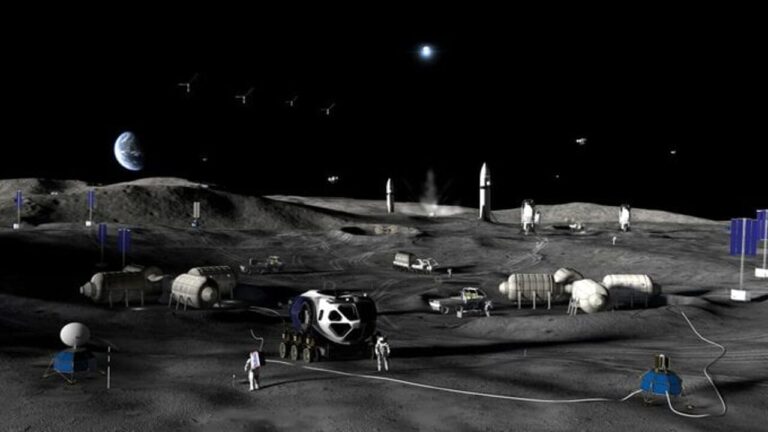
Robotic modules, drones and lunar vehicles to be sent to the Moon to build a permanent base. NASA has revealed to the world the plan to build the first human outpost on our satellite. Yesterday, Tuesday 26 May, the agency announced a series of contracts with private companies to carry out unmanned robotic missions. These are fundamental steps to prepare the ground for the moon landing of the Artemis missions, currently scheduled for 2028.
Contracts with private companies
Among the partners there is also Blue Origin, the space company of Amazon founder Jeff Bezos, with a plan that involves the integration of the Italian Mph habitation module, created by Thales Alenia Space: the Italian Space Agency has in fact announced that it has obtained the approval of a NASA evaluation commission to proceed towards the preliminary review of the project in 2027.
For the development of lunar exploration vehicles (LTVs), NASA has awarded a $219 million contract to Astrolab and a $220 million contract to Lunar Outpost. To deliver these rovers to the lunar south polar region, the agency awarded Blue Origin a $188 million contract, with a renewal option worth approximately $280 million. An additional $75 million allocation was obtained from Firefly Aerospace for the deployment of lunar drones in the MoonFall mission, scheduled for 2028.
The three phases of the program
“The United States will never give up the Moon,” NASA administrator Jared Isaacman said during the press conference. The outpost would allow the US to conduct scientific experiments, extract precious resources and facilitate future trips to Mars. The program, called Ignition Moon Base, is divided into three distinct phases. The initial steps will take place before humans land: The agency plans to send robotic landing modules and hopping drones to explore and map the satellite’s rugged terrain. NASA will exploit Blue Origin systems, equipped with autonomous control and capable of carrying out very precise landings. According to forecasts, the first commercial carriers will touch the ground in the Nobile crater, near the south pole. This first exclusively robotic expedition will last until 2029: scientists have planned 25 launches to transport the first four tons of cargo to the surface.
Infrastructure and humans
The second phase involves the construction of nuclear and solar energy production plants, including fission reactors. The last step will instead consist of sending human beings, who will be able to live in semi-permanent housing modules. The first crew outpost is expected to launch between 2032 and 2033, although analysts warn that it will not be easy to meet the estimated timescales on such a complex mission. The rovers will allow astronauts to move, while the frozen water present at the south pole of the Moon can be used as a drinking resource or to produce oxygen. However, the entire plan hinges on the availability of a spacecraft capable of safely transporting crews from Earth to lunar soil, a step that currently remains critical. SpaceX has a contract to build the Starship Human Landing System, but Elon Musk’s company has had to deal with several technical snags so far.