

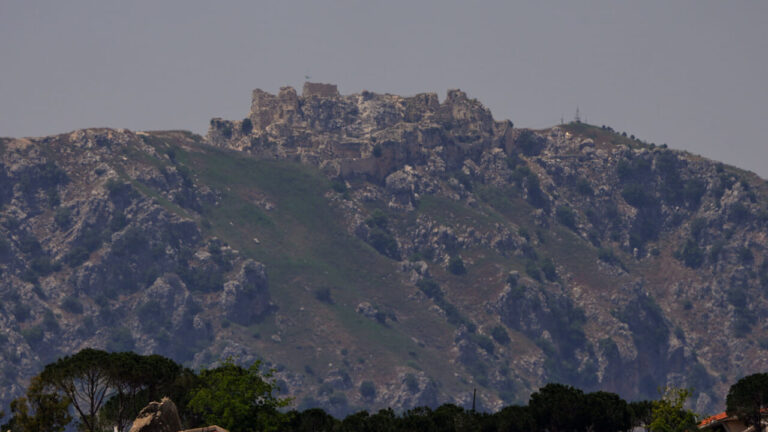
The Israeli army has conquered Beaufort Castle, a historic medieval fortress in southern Lebanon and a strategic point that dominates the surrounding territory up to northern Israel. The Israeli flag and that of the Golani Brigade were raised on the fortress, at the end of an operation kept secret until its completion and announced only after the taking of the site.
What is Beaufort Castle and why is it important
The conquest of Beaufort represents the deepest advance by Israeli forces into Lebanese territory since 2000, the year Israel withdrew from the area after nearly two decades of military presence in southern Lebanon. The castle is located across the Litani River, which after the ceasefire had become the de facto limit of the area controlled by the Israeli army. In recent days the troops have resumed ground operations and have pushed further north, crossing that line and expanding their presence in the territory.
The operation was announced by Defense Minister Israel Katz. “Forty-four years after the heroic battle on Beaufort, and on the day of Remembrance for the fallen of the Shalom HaGalil war and among them the Golani soldiers who fell in the battle for Beaufort, the fighters of the IDF and in the lead the Golani Brigade returned to the summit of Beaufort and once again raised the flag of Israel and the flag of Golani on it,” he wrote on X.
Katz explained that, “at the direction of Prime Minister Netanyahu and myself, the IDF expanded its maneuver in Lebanon, crossed the Litani River and conquered the Beaufort ridge – one of the most important strategic points for the defense of the Galilee settlements and for maintaining the security of our forces.” The minister added that the operation had been kept confidential “to prevent information from reaching the enemy”.
For Israel the value of the conquest is both military and symbolic. Beaufort Castle stands on a promontory that offers a privileged view of southern Lebanon and northern Israel, making it a strategic position for decades to control the area. Built by the Crusaders in the 12th century on the ruins of previous fortifications, the site came over the centuries under the control of Saladin’s troops, the Ottomans, the French administration and later the Palestine Liberation Organization led by Yasser Arafat.
What Netanyahu really wants in Lebanon: Israel has been aiming for the Land of Cedars for fifty years
The Israeli army occupied the fort in 1982 during the invasion of Lebanon, turning it into a military base and maintaining control of it until its withdrawal in 2000. After the Israeli withdrawal, the site was partially restored and opened to the public. In recent days, however, the area has returned to the center of military operations. On Friday, UNESCO, which had placed the castle and 33 other Lebanese sites under special protection since 2024, expressed concern about the bombings nearby.
According to the IDF, the area of Beaufort and the nearby Wadi Saluki hosted important Hezbollah infrastructure, built with Iranian support and used to coordinate military operations and attacks against Israel. The army claims that hundreds of rockets have been fired from the area over time towards Israeli territory and against its troops deployed in southern Lebanon.
Netanyahu’s message and the advance beyond the Litani
Prime Minister Benjamin Netanyahu called the occupation of the castle “a turning point” in the campaign against Hezbollah. In a video message he said: “Today we returned to Beaufort differently. We returned united, determined and stronger than ever.” He then added that “the capture of Beaufort is a very strong image and a radical change in the policy we are conducting. We have broken the barrier of fear. We are taking the initiative, we are operating on all fronts, in Syria, in Gaza, in Lebanon”.
Netanyahu himself confirmed that he had ordered the expansion of military operations beyond the Litani: “I gave instructions to the IDF to extend the maneuver into Lebanon. They crossed the Litani and conquered the Beaufort. Now my order is to consolidate and extend our grip on the territories that were under the control of Hezbollah.”
Katz had a direct message to the Lebanese Shiite movement: “This is a clear message to our enemies: those who threaten the citizens of Israel will lose their strategic assets one after another.” And he reiterated that “the campaign is not over yet. The IDF is strong, and we are all determined to crush the strength of Hezbollah and complete the mission: to guarantee security to the residents of the North”.
France calls for an urgent meeting of the UN Security Council. Macron: “Unjustifiable escalation”
The Israeli advance fuels growing concerns on the international level. France has called for an urgent meeting of the United Nations Security Council to discuss the offensive in Lebanon. According to diplomatic sources, the Council will meet in an emergency session to review the deteriorating situation on the ground and the intensification of military operations in southern Lebanon.
Foreign Minister Antonio Tajani also called for avoiding further escalation. “I believe that an escalation must be avoided in Lebanon. I repeat, Hezbollah cannot continue to bomb northern Israel and Israel must rely more on the United Nations and UNIFIL to try to disarm them,” he declared, underlining the need to strengthen Lebanese institutions and armed forces to promote lasting stabilization.
French President Emmanuel Macron also spoke on the situation, expressing strong concern about the ongoing developments. “Nothing justifies the serious escalation underway in southern Lebanon. France will continue to support the Lebanese authorities in their efforts to restore the state sovereignty and territorial integrity of the country,” he wrote in a message published on X.
Macron also held talks with Saudi Crown Prince Mohammed bin Salman, Omani Sultan Haitham bin Tariq, United Arab Emirates President Mohammed bin Zayed and Egyptian President Abdel Fattah al-Sisi, placing the Lebanese crisis in the broader framework of regional tensions. For the French president “it is essential to quickly reach an agreement between the United States and Iran. We must seize this opportunity now”. The priority, according to Macron, must be “the conclusion of a ceasefire and the immediate reopening of the Strait of Hormuz, without preconditions and in compliance with international law”. The head of the Elysée also supported the need to continue negotiations on broader dossiers, from Iranian nuclear and missile programs to regional security. “We must start from Lebanon, where it is urgent that all weapons remain silent, forever.”
I met with the Royal Prince of Saudi Arabia Mohammed Ben Salman, the Sultan of Oman Haïtham Bin Tariq, the President of the United Kingdom Mohammed Ben Zayed and the President of Egypt Abdefattah Al Sissi.
Anyway, I bring the same message: this is the essential thing…
— Emmanuel Macron (@EmmanuelMacron) May 31, 2026
The conquest of Beaufort comes as the Israeli army has expanded its evacuation orders aimed at the civilian population and has designated a large portion of southern Lebanon as a combat area, up to the Zahrani river line, about forty kilometers north of the border. A dynamic that confirms the expansion of Israeli operations and fuels fears of a further expansion of the Lebanese front.